.png)
Artificial Intelligence (AI) is everywhere in today's business conversations. At the same time, companies continue investing heavily in automation to save time, reduce costs, and improve efficiency. But what
But here's the catch: automation, AI, and AI Agents are often used interchangeably, even though they represent very different technologies.
Understanding the difference is becoming increasingly important. Not only because it helps organisations invest wisely, but also because the conversation is rapidly evolving. What started with automation has expanded to AI, and today, many businesses are already exploring AI Agents.
Let's break down the differences, look at real-world examples, and explore where each technology fits within a modern organisation.
What Is Automation?
At its core, automation is about rules and repetition. You tell a system exactly what to do, and it performs that task consistently every time.
Definition
Automation executes predefined, rule-based tasks with little to no human intervention.
Examples
- Automatically routing invoices to the right approver
- Scheduling recurring email reminders
- Generating monthly financial reports in your ERP system
- Creating tickets when specific alerts are triggered
Benefits
- Increased efficiency
- Reduced manual effort
- Fewer human errors
- Lower operational costs
💪 Think of automation as the muscle of your business processes. It removes repetitive work, but it doesn't think, learn, or adapt.
What Is Artificial Intelligence?
Artificial Intelligence takes things a step further. Instead of following fixed rules, AI is about analysing information, identifying patterns, and making predictions based on data.
Definition
Artificial Intelligence enables systems to simulate human-like intelligence by analysing information, reasoning, learning from data, and generating insights.
Examples
- A chatbot that improves responses based on previous interactions
- Fraud detection systems identifying unusual transaction patterns
- Predictive maintenance systems analysing sensor data
- AI-powered document processing solutions
- Microsoft Copilot helping employees draft content and analyse information
Benefits
- Flexibility and adaptability
- Better decision support
- Insights beyond traditional reporting
- Ability to work with unstructured data
🧠 If automation is the muscle, AI is the brain. It helps organisations understand information and make better decisions.
Automation vs AI: The Key Differences
Although they often work together, automation and AI solve different problems.
| Aspect | Automation |
Artificial Intelligence |
|---|---|---|
| Decision-making | Follows predefined rules | Learns from data |
| Flexibility | Limited | Adaptive |
| Input | Structured data | Structured and unstructured data |
| Goal | Efficiency and consistency | Intelligence and optimisation |
| Best for | Repetitive tasks | Complex decision-making |
For years, this distinction was sufficient. Today, however, another layer is being added.
Enter AI Agents
Unlike automation, which follows predefined rules, and unlike AI, which primarily provides recommendations or insights, AI Agents can take action autonomously to achieve a specific goal.
Definition
An AI Agent is an AI-powered system capable of reasoning, planning, making decisions, and executing actions with minimal human intervention.
In simple terms:
- Automation follows instructions.
- AI provides intelligence.
- AI Agents perform work.
Seeing the Difference in Action
The easiest way to understand the evolution is through a practical example: An invoice arrives.
-
Automation:
-
automatically forwards it to the correct approver based on predefined rules.
-
-
Artificial Intelligence:
- Reads the invoice
- Extract the relevant information
- Recognises suppliers
- And identifies potential anomalies
-
AI Agents:
-
- Read the invoice
- Extract the relevant information
- Validate the purchase order
- Check spending limits
- Detect anomalies
- Request approval when required
- Follow up automatically
- Prepare the payment proposal
The employee only becomes involved when an exception occurs. This is where many organisations see the next wave of productivity gains.
The Evolution Of Business Technology
Many organisations are progressing through a similar maturity journey.
| Stage | Objective |
|---|---|
| Digitisation | Move from paper to digital processes |
| Automation | Eliminate repetitive tasks |
| AI Assistance | Support employees with intelligence |
| AI Agents | Delegate tasks and workflows |
| Autonomous Operations | AI-driven business processes |
The question is no longer whether AI will impact your organisation, but where does your organisation currently stand?
Why Businesses Still Confuse Automation, AI, and AI Agents
Several factors contribute to the confusion.
-
Marketing hype: Many vendors label traditional automation as "AI" because it sounds more innovative.
-
Similar outcomes: All three technologies aim to improve efficiency and reduce manual work.
-
Rapid Evolution: Modern solutions increasingly combine automation, AI, and AI Agents into a single platform, making the boundaries less obvious.
When To Use What?
The right choice depends on your objective.
| Use automation when | Use AI when | Use AI Agents when |
|---|---|---|
|
|
|
However, together, they create a powerful foundation for the next generation of business processes.
How Easi Helps
At Easi, we help organisations understand where automation is sufficient, where AI adds value, and where AI Agents can unlock entirely new possibilities.
Whether it's streamlining ERP processes, implementing intelligent document processing, leveraging Microsoft Copilot, or exploring AI-driven business workflows, our goal remains the same: Deliver practical technology with measurable business value that help people.
Conclusion
The conversation has evolved. Where it used to be simply about automation versus AI, AI Agents are introducing a new way of working. They don't just follow rules or provide recommendations, but actively help organisations achieve outcomes.
Understanding the difference between automation, AI, and AI Agents is the first step toward making informed decisions about the future of your business.
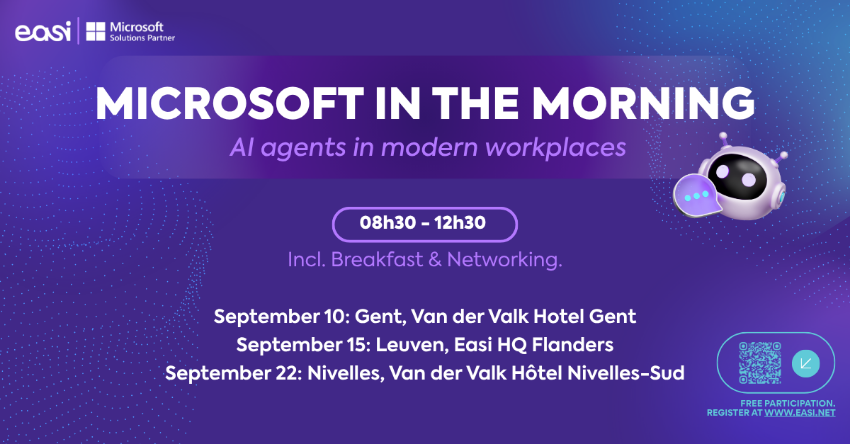
Join our upcoming AI event
Ready for the next step beyond automation and AI? Discover how organisations are leveraging AI Agents, Vibe Coding, and modern AI platforms to drive innovation, productivity, and business value... both within and beyond the Microsoft ecosystem.