.png)
AI is evolving at an unprecedented pace. For many organisations, the first wave of artificial intelligence was mainly about experimentation: testing ChatGPT, exploring Microsoft Copilot, summarising documents, drafting emails or asking AI to support everyday knowledge work.
That first phase was important. It helped employees and management teams understand what generative AI could do. But the conversation is now shifting. The next step is not simply about asking better prompts or choosing the most powerful model. It is about AI becoming more deeply embedded in the way organisations work.
This is where AI agents enter the picture. An AI agent is often described as a digital colleague: a system that can perform tasks autonomously, make decisions within predefined boundaries and interact with people, data and business applications. In practice, this means AI is moving from answering questions to executing workflows.
For Belgian SMEs, this creates both opportunity and uncertainty. The potential is clear, but so are the questions.
-
What exactly can AI agents do?
-
Should organisations start now or wait until the technology is more mature?
-
How do regulations such as the AI Act fit into this evolution?
-
And most importantly: how can companies move from experimentation to real business impact?
Editor’s note: this article was originally published as an interview with Olivier Cuyvers in Voka Magazine Ondernemers | Vlaams-Brabant 2026 #6.
AI Is Moving Beyond the Prompt
Most organisations today still interact with AI through prompts. A user asks a question, the system generates an answer and the human decides what happens next. This is already useful in many contexts, especially for tasks such as writing, summarising, translating or analysing information.
AI agents go one step further. They do not only respond to a request, but can also take initiative within a predefined framework. They can analyse incoming information, determine the next steps, consult other systems, prepare output and escalate when human validation is required.
A simple example is an incoming request for a quotation:
-
A traditional AI assistant can help draft a reply. An AI agent could go further by analysing the request, checking customer information, retrieving product or pricing data, preparing a proposal and sending it to the right person for approval.
-
The human remains in control, but the way work is organised changes significantly. Instead of supporting one isolated task, AI starts supporting an entire process.
That is why AI agents should not be seen as a slightly more advanced chatbot. They represent a new phase in automation, where AI becomes part of operational workflows rather than a separate tool employees use from time to time.
Why Waiting Is Not Always the Safe Option
Olivier Cuyvers, AI expert at Easi, recognizes that many companies are still cautious. That is understandable. AI is evolving quickly, the market is crowded and new tools appear constantly. For management teams, it can feel risky to invest too early in technology that may look different six months from now.
However, waiting also carries a risk: The real challenge of AI adoption is rarely limited to the technology itself. Organisations need to understand where AI can create value, which processes are suitable, how employees will use it, which data is needed and where governance is required. These are not questions that can be solved overnight.
Companies that start today build experience. They learn which use cases are realistic, which departments are ready, which internal concerns need to be addressed and which quick wins create momentum. That learning curve becomes a competitive advantage.
Waiting until the technology is “finished” may sound safe, but AI will continue to evolve. There will always be a newer model, a better tool or a more advanced platform. Organisations that postpone every decision until the market stabilises risk standing still while others are already building internal maturity.
%202%20(1).jpg?width=400&height=254&name=Olivier%20Cuyvers%20(Easi)%202%20(1).jpg) The key is not to implement everything at once. The key is to start deliberately, with clear priorities and realistic expectations.
The key is not to implement everything at once. The key is to start deliberately, with clear priorities and realistic expectations.
"The real work isn't choosing the right AI tool. It's helping your organisation adopt the right mindset. That takes time. Companies that start today are already building experience, while those who wait risk falling two steps behind."
The Tool Is Not the Strategy
One of the most common mistakes in AI adoption is focusing too much on the tool. Today, many conversations revolve around OpenAI, Anthropic, Claude, Microsoft Copilot or Google Gemini. These technologies matter, but they should not define the entire AI strategy of an organisation.
The AI landscape will keep changing. Models will improve, pricing will evolve and new players will enter the market. A company that builds its strategy around one specific technology risks becoming dependent on decisions outside its control.
A stronger approach is to focus on the foundations: processes, data, security, governance and adoption. Organisations that understand their workflows and have their data architecture in order will be better positioned to benefit from whichever model proves most suitable in the future.
In other words, the question should not only be: which AI tool should we use? A better question is: how do we make our organisation ready to use AI safely, effectively and sustainably?
"The value isn't in the tool itself. It's in your processes and your data architecture. Those are the foundations that will outlast every new AI model," explains Olivier.
AI Agents Require Clear Boundaries
As AI systems become more autonomous, governance becomes more important. This is especially true for AI agents, because they are designed to execute tasks rather than simply provide suggestions.
Organisations must define what an AI agent is allowed to do, which data it may access, when human approval is required and how output will be monitored. Without those boundaries, AI adoption can quickly become fragmented or risky.
This is also where the European AI Act becomes relevant. For many SMEs, regulation may initially feel like an extra burden. In reality, it can also provide a useful framework. Companies need to know which AI systems they use, what risks are involved and how human oversight is guaranteed.
That should not be seen purely as compliance. Responsible AI use can strengthen trust with customers, employees and partners. Organisations that can explain how they use AI, how they manage risk and how they protect data will be better positioned than those that treat AI as an uncontrolled experiment.
In the coming years, trust will become an important differentiator. Not only in whether companies use AI, but in how they use it.
From Inspiration to Adoption
In our previous article on AI adoption, we explained why the real challenge is not experimenting with AI, but creating lasting business value. AI agents represent the next logical step in that journey. Once organisations understand where AI creates value, the question becomes how far AI can support or even execute complete workflows.
In practice, organisations tend to move through different stages in their AI journey.
-
Some companies are still at the beginning. They want to understand what AI can mean for their business and need inspiration, practical examples and concrete use cases. For them, the priority is not building a complex platform, but identifying where AI can create value quickly and safely.
-
Other organisations have already experimented with AI. They may have tested Copilot, launched a pilot project or introduced AI tools in specific teams. Their challenge is different: how do they move from isolated experiments to broader adoption? How do they ensure that AI is not only used by a few enthusiastic employees, but becomes part of everyday work?
-
A third group is already thinking further ahead. These organisations want to build a secure and scalable AI foundation for the long term. They focus on data, integrations, governance, security and platform choices. For them, AI is no longer an experiment, but a strategic capability.
Each stage requires a different approach. What they have in common is that progress starts with clarity. Organisations need to know where they stand today, where AI can create value and which steps are realistic in the short term.
AI Adoption Is a Business Transformation
AI is often introduced as a technology topic, but its impact reaches much further. It changes how people work, how decisions are prepared, how information flows and how repetitive tasks are handled.
That is why AI adoption cannot be left to IT alone.
Management needs to define direction. Business teams need to identify relevant use cases. Employees need to understand how AI supports their work. Security and compliance teams need to create a responsible framework. Without that alignment, AI initiatives remain fragmented and their impact stays limited.
The most successful organisations are not necessarily those that move the fastest. They are the ones that connect AI initiatives to real business needs. They look at recurring frustrations, inefficient workflows, manual administration or knowledge that is difficult to access. From there, they determine where AI can make work faster, smarter or more consistent.
This pragmatic approach is especially relevant for SMEs. AI does not need to start with a large transformation programme. It can start with one process, one department or one clear use case. What matters is that every initiative contributes to learning and creates momentum for the next step.
The Future of Work Will Be Human and AI Together
The rise of AI agents does not mean that people disappear from business processes. It means their role changes.
AI can take over repetitive steps, collect information, prepare output and accelerate decisions. People remain essential for judgement, empathy, creativity, ethical considerations and final responsibility. The value lies in the collaboration between both.
This is an important nuance. Organisations that position AI as a replacement for employees will often create resistance. Organisations that position AI as a way to remove repetitive work and support better decision-making are more likely to build trust and adoption.
AI agents should therefore be introduced as part of a broader evolution in work. They can help employees focus on what matters most, but only if the organisation provides the right context, training and governance.
Technology may enable the change, but people determine whether it succeeds.
The Moment to Prepare Is Now
AI will not stop evolving. Models will become more powerful, agents will become more capable and business applications will increasingly include AI-driven features by default. For organisations, this means that AI will gradually become less of a separate topic and more of a natural part of everyday operations.
The companies that benefit most will not be those that waited for the perfect moment. They will be the ones that started building experience early, learned from practical use cases and created the foundations for responsible adoption.
The message is not that every company needs to implement AI agents tomorrow. The message is that every company should start preparing today.
"Companies that want to remain competitive will need both human employees and AI agents."
- Olivier Cuyvers, AI expert at Easi
That preparation begins with the right questions. Which processes consume too much time? Which tasks are repetitive? Which decisions depend on scattered information? Which data is available? Which risks need to be managed? And where can AI create value without adding unnecessary complexity?
By answering those questions, organisations move from curiosity to direction. That is where real impact begins.
Need help with AI adoption or preparation?
Implementing AI is one thing. Ensuring that initiatives truly align with the reality of your organisation is another. In practice, we see that SMEs that start from clear use cases achieve results faster. A pragmatic approach — aligned with processes, people, and objectives — makes all the difference.
👉 Learn more about our Artificial Intelligence solutions
👉 Get in touch with our experts to discuss your AI challenges
Discover What AI Can Mean for Your Organisation
AI agents are not just another hype cycle. They are part of a broader shift in how organisations will use technology to support people, processes and decision-making.
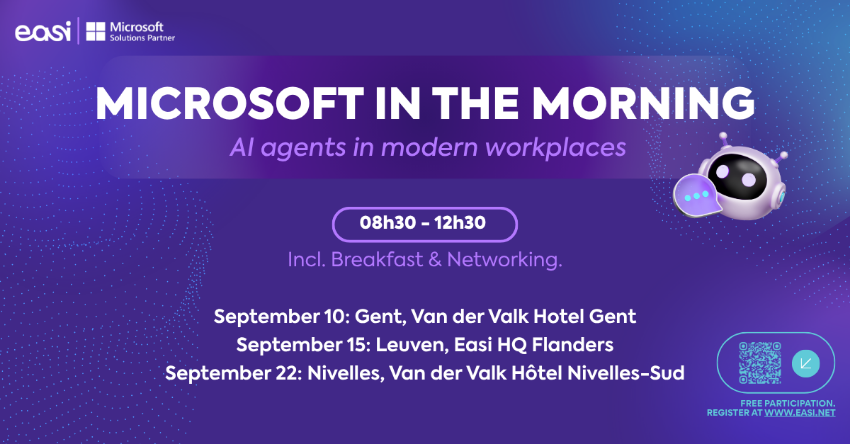
During our upcoming AI event in September, we will explore how organisations can move beyond experimentation and prepare for the next phase of AI adoption. Our AI experts will share practical insights, real examples and concrete guidance on how to approach AI in a secure, pragmatic and value-driven way.
Whether your organisation is still exploring AI, scaling first initiatives or preparing for a more advanced AI platform, the most important step is the same: start with a clear understanding of where AI can create value: the future of AI will not be defined by the tool you choose today. It will be defined by how well your organisation is prepared to use it tomorrow.